Probability-Driven Approaches to Bonus Optimization in Mobile Poker Environments Serving Canadian Players
Written by Zoe Patterson · Nov 20, 2026

Probability-Driven Approaches to Bonus Optimization in Mobile Poker Environments Serving Canadian Players
Canadian players accessing mobile poker applications encounter layered bonus systems that reward consistent participation while incorporating wagering requirements tied to deposit amounts and game volume. Operators structure these incentives around deposit matches, cashback percentages on rake, and leaderboard rewards for tournament entries, all of which respond to regional licensing frameworks across provinces. Data from industry reports indicate that effective bonus utilization hinges on accurate probability assessments rather than random selection of promotions.
Core Elements of Mobile Poker Bonus Mechanics
Bonus optimization begins with mapping the mathematical structure of each offer, including playthrough multipliers that range from 10x to 30x on average, alongside restrictions that exclude certain game types from contribution counts. Players calculate the expected return by factoring in the base probability of completing requirements before expiration dates, typically set between 30 and 90 days depending on the provider. Studies from research institutions show that variance in poker outcomes directly influences completion rates, prompting many participants to track session-level win rates against historical hand distributions stored within app analytics tools.
Provincial differences add another layer because Ontario's regulated market enforces distinct self-exclusion integrations compared to other regions where operators operate under different oversight. Those who study these patterns note that bonus value often correlates with player retention metrics tracked by platforms, where algorithms adjust future offers based on individual engagement data collected over multiple months.
Applying Probability Models to Maximize Returns
Expected value calculations form the foundation of probability-driven strategies, where participants multiply the likelihood of achieving bonus milestones by the net payout after fees and subtract the inherent house edge present in cash games or sit-and-go formats. Advanced users incorporate binomial distributions to model sequences of wins and losses needed to clear playthrough conditions, adjusting bet sizing to stay within optimal ranges that preserve bankroll integrity. Research indicates that incorporating real-time hand equity software alongside bonus trackers improves decision accuracy during live sessions, particularly when multi-tabling across several mobile applications.
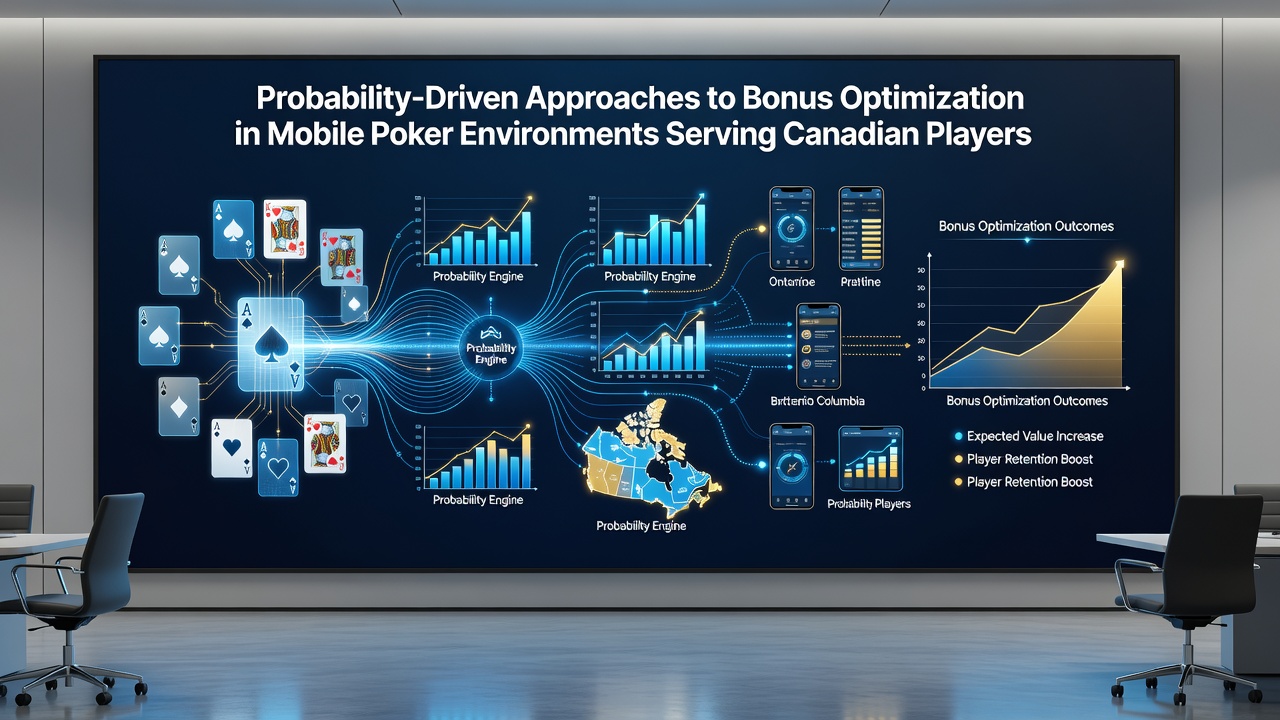
Monte Carlo simulations appear frequently in player communities because they generate thousands of outcome scenarios based on historical variance data, revealing the percentage chance that a given bonus will yield positive return after all conditions are met. Observers note that November 2026 updates to certain apps introduced dynamic bonus multipliers that shift according to aggregated player activity levels, requiring updated models to account for these fluctuating parameters. Those who've examined large datasets from public poker forums report that players who combine probability tables with bankroll management spreadsheets achieve higher completion rates across seasonal promotion cycles.
Data Sources Informing Strategy Adjustments
Figures released by the Canadian Gaming Association highlight steady growth in mobile poker participation through 2026, with bonus redemption patterns varying by province and device type. Academic analyses from the National Center for Responsible Gaming further demonstrate that structured probability approaches reduce the impact of short-term variance on long-term bankroll stability when applied consistently. Operators respond to these trends by refining their loyalty tiers, where point accumulation rates tie directly to measured play frequency rather than random distribution.
Integration of API-driven tools allows real-time updates to probability assessments as new bonus structures roll out, while compliance requirements ensure that all optimization methods remain within platform terms. Experts tracking these developments observe that cross-referencing multiple data streams, including rakeback percentages and tournament overlay statistics, produces more reliable forecasts than single-metric evaluations.
Conclusion
Probability-driven methods continue to shape how participants interact with mobile poker bonuses across Canadian markets as platforms refine their offerings through 2026 and beyond. Accurate modeling of expected outcomes, combined with attention to regulatory variations, supports sustained engagement without reliance on chance alone. Ongoing data collection from regulatory bodies and research organizations supplies the foundation for these evolving practices.